
Beneath the streets of the Gothic Quarter (and, in some spots, clearly visible at street level) lies one of the oldest structures in all of Barcelona: the Roman wall. This article answers the question many people ask before visiting the city: what exactly is Barcelona's Roman wall, where can you see it today, and how can you trace its route without missing anything important?
What Barcelona's Roman wall is
The Roman wall is the defensive perimeter that surrounded Barcino, the Roman colony founded around 10-15 BC that gave rise to today's Barcelona. The first wall, built in the 1st century BC, enclosed a relatively small, elliptical city of about 10 hectares.
In the 3rd century AD, faced with increasing incursions by Germanic peoples, a second, much more robust wall was built: around 1,300 metres in perimeter, with defensive towers every few metres. It's precisely this second phase, from the 3rd century, that survives best today and that most visitors can see in the Gothic Quarter.
Map and route of the Roman wall: where to see it today
Although no complete stretch remains in the open air, you can trace much of the original route on foot through specific streets and squares of the Gothic Quarter:
- Plaça Nova: the most spectacular and accessible spot. Two original defensive towers flank the entrance to the Gothic Quarter, with a clearly visible wall fragment.
- Carrer de la Tapineria: follows almost in a straight line the route of the eastern wall, with visible sections built into the façades of later buildings.
- Plaça de Ramon Berenguer el Gran: here you can see a long stretch of wall with a semicircular tower, one of the best-preserved fragments in the whole city.
- Plaça dels Traginers: another Roman tower, in very good condition, surrounding an old stretch of wall.
- Capella de Santa Àgata (former Palau Reial): built literally on top of a Roman wall tower, integrated into the Palau Reial Major complex.
- Baixada de la Canonja and Carrer del Bisbe: other spots where the later medieval layout still follows, even today, the line of the original wall.
This route can be done perfectly on foot and on your own, since most of the points are signposted and freely accessible in public space.
Why the wall was extended in the 3rd century
The construction of the second wall, much thicker and more fortified than the first, responds to a specific historical context: the 3rd-century crisis of the Roman Empire, marked by Germanic invasions (such as the Franks, who sacked the northeast of the peninsula in 260 AD), political instability, and the growing militarisation of frontier cities.
Barcino, despite not being a major metropolis, held a strategically important position on the Mediterranean coast, which made it a target worth protecting. The new wall, with towers roughly every 30 metres, is one of the best-preserved examples of this type of late Roman fortification anywhere in Hispania.
The second life of the walls: from Roman to medieval
The Roman wall wasn't the only one to surround Barcelona. As the city grew during the Middle Ages, it needed new, much larger walls, which through successive extensions (in the 13th and 14th centuries) came to enclose El Raval and part of what is now the Eixample. Even fewer visible remains survive of these medieval walls, much bigger than the Roman one, since most were torn down in the 19th century to allow the city to expand.
This succession of walls (Roman, medieval and, finally, the 18th-century military citadel) explains why Barcelona took so long to grow beyond its old core: for centuries, the city was literally locked within its own defensive walls, a constraint that wasn't resolved until the walls were demolished and the Cerdà Plan was implemented in the mid-19th century.
Visiting the wall with context: the MUHBA and the Barcino free tour
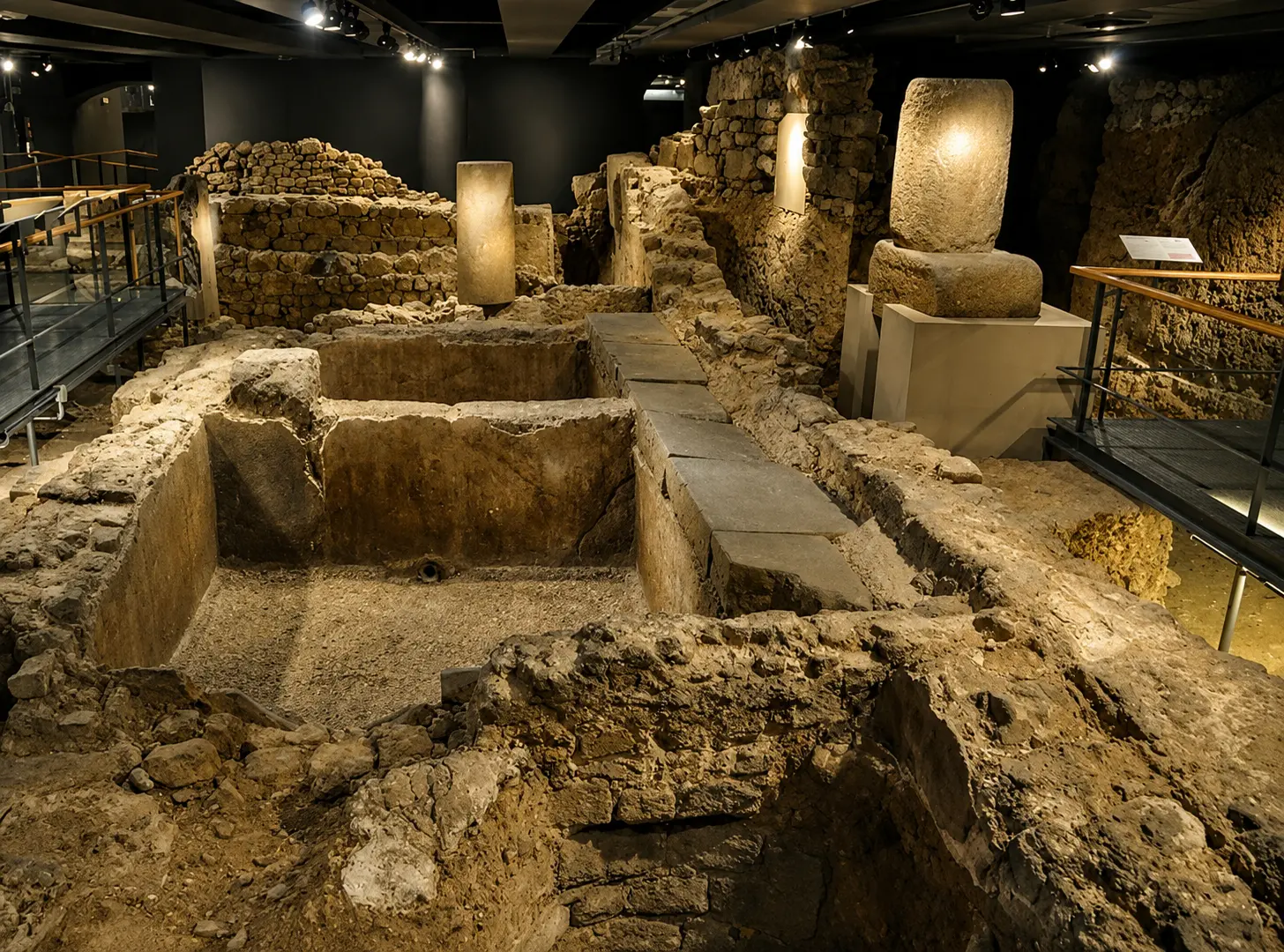
Seeing the wall "from the outside" is already interesting, but the MUHBA (Museum of the History of Barcelona), at Plaça del Rei, lets you go a step further: descend underground and walk literally along the streets of Roman Barcino, past remains of roads, workshops, and even an old fish-salting factory. It's the most complete way to understand what life was like behind those walls. If you'd like to know more, see our dedicated guide on what to visit at the MUHBA.
If you'd rather have someone tell you the story as you walk, our Barcino: The Roman City free tour covers precisely this route (Plaça Nova, Carrer del Bisbe, the Temple of Augustus and the forum), with a historian guide, pay-what-you-want.
Frequently asked questions about Barcelona's Roman wall
Where is Barcelona's best-preserved Roman wall?
The stretch at Plaça de Ramon Berenguer el Gran and the towers at Plaça Nova are generally considered the best-preserved and most accessible fragments of the whole route. The tower built into the Capella de Santa Àgata is also an exceptional example of medieval reuse of a Roman structure.
Does any original gate of the wall survive?
No complete gate survives in the open air, but the layout of the old gates can be inferred at spots like the Baixada de la Canonja, near the Cathedral, where the entrance to the Roman city roughly coincided with today's access to the cathedral precinct.
What's the difference between the first and second wall?
The first wall (1st century BC) was simpler and enclosed a smaller city. The second (3rd century AD) is much more robust, with towers every few metres, built in response to the political instability and Germanic incursions of that period. Most of the remains visible today belong to this second phase.
Can you take a guided tour specifically about the wall?
Yes, our Barcino: The Roman City free tour includes detailed explanations about the evolution of the wall, why it was extended, and how it relates to the rest of the Roman remains in the Gothic Quarter.
Can you touch the Roman wall?
At most points, yes: it's outdoor public space, with no display cases or protective barriers, since it's part of the Gothic Quarter's own urban fabric. Of course, we recommend treating it with the respect a nearly two-thousand-year-old monument deserves.
Practical tips for the visit
- Duration: tracing the wall's main points on your own takes between 45 minutes and 1 hour, not counting the MUHBA.
- Best time: early morning, when the side light makes the relief of the stones more visible and there are fewer people around.
- Accessibility: the whole route runs along flat, mostly pedestrian streets, suitable for any fitness level.
- Free: seeing the wall from public space costs nothing; only the MUHBA and certain indoor spaces require an entrance fee.
Whether on your own with this guide, or accompanied by a historian guide on our free tour or audio tour, Barcelona's Roman wall is one of the few opportunities in Europe to literally touch 1,800 years of history in the middle of a modern city.