
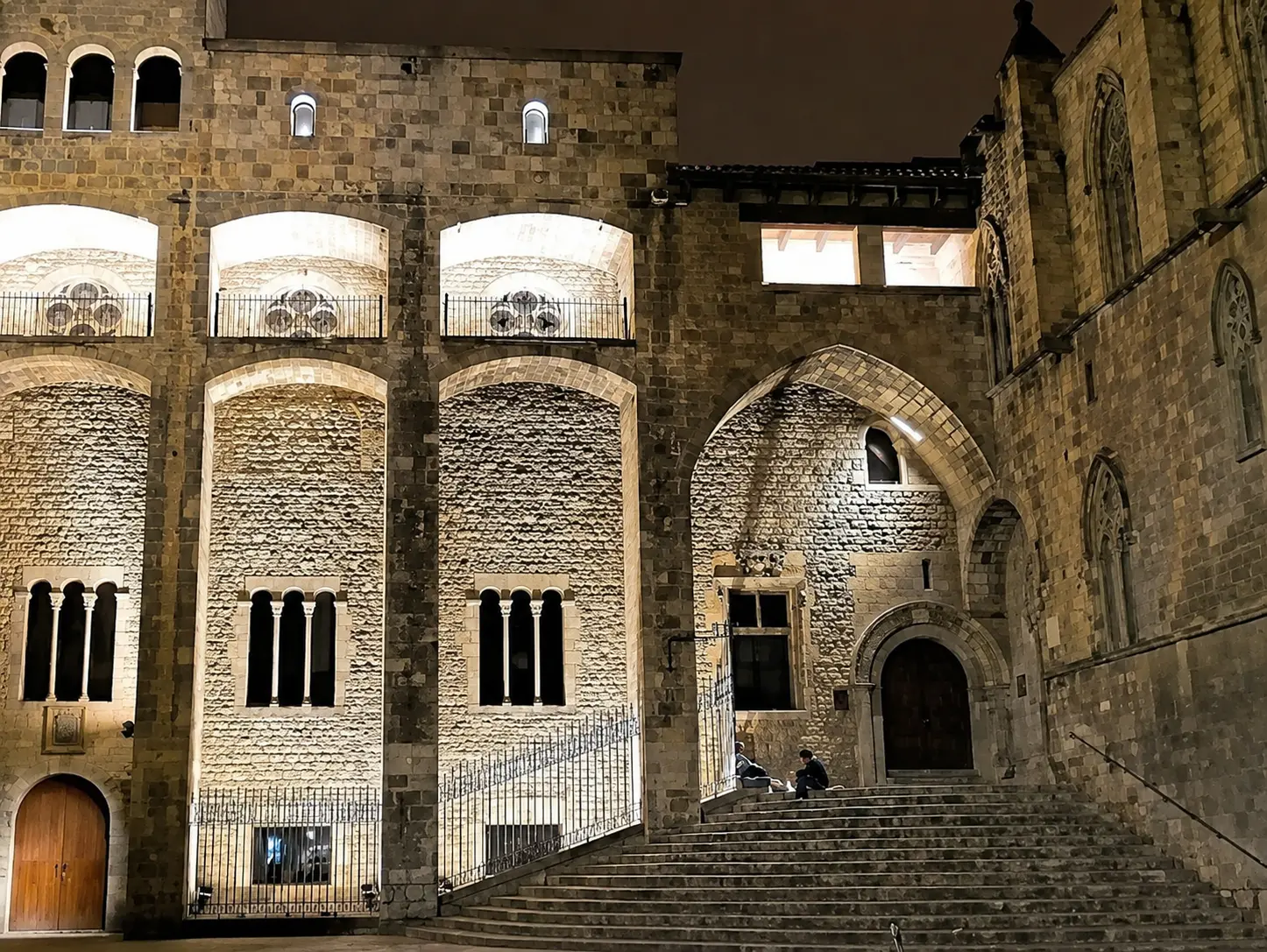
The MUHBA (the Museum of the History of Barcelona) is, probably, the most impressive museum experience for understanding what life was like in Roman Barcelona. Its main site, at Plaça del Rei, lets you do something few museums in the world offer: go literally underground and walk the streets of a two-thousand-year-old city. This guide explains what to see, how to plan the visit, and how much it costs.
What the MUHBA is and why it's different from a conventional museum
Unlike a traditional museum, where objects are displayed in cases outside their original context, the MUHBA at Plaça del Rei has you walk directly over the original archaeological remains of Barcino, the Roman colony that gave rise to Barcelona. It's an underground site of roughly 4,000 m², one of the largest in Europe within a continuously inhabited urban core.
The museum also manages several other sites scattered around the Gothic Quarter and other parts of the city (such as the Palau Reial Major, part of El Call and remains of the Roman baths), but the Plaça del Rei site is, by far, the most complete visit and the recommended starting point.
What to see at the MUHBA, Plaça del Rei
- Original Roman streets and roads: you can literally walk the urban layout of Barcino, with pavements and drainage systems still visible.
- Remains of homes and workshops: including an old fish-salting factory (garum) and a textile dyeing workshop.
- An old wine cellar and press: evidence of local wine production during the Roman era.
- Remains of an early Christian basilica: from the period when Christianity was taking hold in the city, between the 4th and 6th centuries.
- The Saló del Tinell: back at street level, one of the most imposing civil Gothic spaces in Barcelona, part of the Palau Reial Major.
- The Capella de Santa Àgata: a Gothic chapel built literally on top of a Roman wall tower.
Other MUHBA sites across the city
Many people don't realise the MUHBA isn't a single building but a network of archaeological sites and historic spaces spread across Barcelona, all managed by the same museum. Among the most notable:
- Via Sepulcral Romana: a 1st-century Roman necropolis, next to Plaça de la Vila de Madrid, very close to Plaça Catalunya.
- Temple of Augustus: the four Roman columns on Carrer del Paradís, a few metres from the main site.
- Refugi 307: a Civil War air-raid shelter excavated in Poble-sec, a witness to the bombings the city suffered between 1936 and 1939.
- Turó de la Rovira: the remains of a Civil War anti-aircraft battery, today one of the city's most popular free viewpoints.
- Fabra i Coats: a former textile factory in the Sant Andreu neighbourhood, an example of Barcelona's industrial heritage.
Each of these spaces has different opening hours and access conditions (some are free entry, others require advance booking), so if you want to visit any of them beyond the Plaça del Rei site, it's worth checking in advance on the museum's official website.
Opening hours and indicative prices (2026)
Museum hours and prices can change, so we always recommend confirming them on the official website before your visit. As a rough guide:
- Hours: Tuesday to Saturday, 10am to 7pm; Sundays, 10am to 8pm. Closed Mondays.
- Price: general admission around €7, with a reduced rate around €5.
- Free admission: under-16s, and Sundays from 3pm onward (as well as the first Sunday of every month, all day, according to the municipal calendar).
How to get there
The MUHBA at Plaça del Rei is right in the middle of the Gothic Quarter. The nearest metro stop is Jaume I (L4), less than 5 minutes on foot. It's also easily reached on foot from the Cathedral or Plaça Sant Jaume, since it's part of the same medieval and Roman monumental core.
How much time you need for the visit
To see the underground site and the Saló del Tinell at a relaxed pace, allow 1 to 1.5 hours. If you want to explore each area in depth (including the information panels and audiovisual recreations), you can easily reach 2 hours.
A good strategy is to combine the MUHBA visit with a walk through the rest of the Gothic Quarter (the Roman towers at Plaça Nova, the Temple of Augustus and the route of the wall), for a complete picture of Roman Barcino, both underground and at street level. See all the details in our guide on Barcelona's Roman wall.
Frequently asked questions about the MUHBA
Do you need to book MUHBA tickets in advance?
It's not usually essential outside peak season, but on the busiest dates (summer, long weekends and public holidays) we recommend buying tickets in advance on the official website to avoid queues outside Plaça del Rei.
Is the MUHBA's underground site accessible?
The museum has a lift and routes adapted for people with reduced mobility, though some specific points of the site may have limitations due to its archaeological nature. We recommend checking the current accessibility conditions on the official website.
Can you take photographs inside the MUHBA?
Yes, photography without flash is generally allowed in most areas of the museum, both in the underground site and in the Saló del Tinell.
Is the MUHBA the same as the Museu Picasso?
No, they're different museums. The MUHBA focuses on the urban history of Barcelona from the Roman era to today, with its main site at Plaça del Rei. The Museu Picasso, on Carrer Montcada, is dedicated exclusively to the early work of the Málaga-born artist.
Is the MUHBA worth it if I've already done a Barcino free tour?
Absolutely. The free tour gives you the story and the context at street level; the MUHBA lets you see with your own eyes, and at your own pace, the remains your guide described during the route. They're complementary experiences, not redundant ones.
Can you reach the MUHBA on foot from Las Ramblas?
Yes, it's a short distance: about 10 minutes on foot crossing the Gothic Quarter from any point on Las Ramblas to Plaça del Rei, a walk that already lets you spot a few fragments of the Roman wall along the way.
Are there discounts for students or families at the MUHBA?
Yes, the museum usually offers reduced rates for students, unemployed people and large families, in addition to free admission for under-16s. We recommend bringing supporting documentation and confirming current conditions on the official website.
MUHBA or free tour: which to choose?
You don't have to choose: they're complementary experiences. The MUHBA lets you see the original remains at your own pace, for as long as you like; a guided free tour like ours gives you the story and the historical context, connecting what you'll see at the museum with the rest of the Roman sites visible around the Gothic Quarter, many of which aren't part of the official museum route.
Many of our visitors combine both: they do the free tour first to get the general context, then come back on their own to the MUHBA to explore the underground site at leisure. You can also do the route with our self-guided audio tour before or after visiting the museum.