
The Gothic Quarter is the historic heart of Barcelona and, probably, the neighbourhood with the highest density of heritage in the whole city. Within a radius of little more than a kilometre you'll find 2,000-year-old Roman columns, medieval palaces, the old Jewish quarter and some of the most photographed streets in Europe. If you only have one day to get to know Barcelona, this is the neighbourhood to start with.
In this guide we explain what to visit in the Gothic Quarter, what itinerary to follow, how much time you need, and how to turn the visit into a meaningful experience, not just a collection of photos.
Why the Gothic Quarter is a must-visit
The Gothic Quarter occupies the site of ancient Roman Barcino, the colony founded in the 1st century BC that, centuries later, became the medieval core of comital Barcelona. This double layer (Roman and medieval) is what makes the neighbourhood unique: you can walk the very street grid the Romans used, and a few metres further on run into a 14th-century Gothic palace.
Unlike other European old towns, the Gothic Quarter isn't a stage set: it's a living neighbourhood, with residents, century-old shops, and a street life that still sets the rhythm of the city.
The 10 must-see spots in the Gothic Quarter
- Barcelona Cathedral (Cathedral of the Holy Cross and Saint Eulalia): the most imposing Gothic building in the neighbourhood, with a cloister that has been home to thirteen geese for centuries.
- Plaça Nova and the Roman towers: the best place to start understanding Barcino, with two original defensive towers still standing.
- The Temple of Augustus: four 1st-century BC Roman columns, hidden inside a courtyard on Carrer del Paradís, a few metres from the Cathedral.
- Plaça del Rei and the Palau Reial Major: the palace complex of the counts of Barcelona and kings of Aragon, where Columbus was received by the Catholic Monarchs in 1493.
- El Call, the old Jewish quarter: a maze of narrow streets that was once home to one of the most important Jewish communities of the medieval Mediterranean.
- Plaça de Sant Jaume: Barcelona's political centre for centuries, with the City Hall and the Palau de la Generalitat facing each other.
- Carrer del Bisbe and its neo-Gothic bridge: one of the most photographed corners of the city, even though the bridge is actually from the 20th century.
- Plaça Reial: a 19th-century arcaded square with palm trees and lamp posts designed by a young Antoni Gaudí.
- Basílica de Santa Maria del Pi: Catalan Gothic in its purest form, with one of the largest rose windows in Europe.
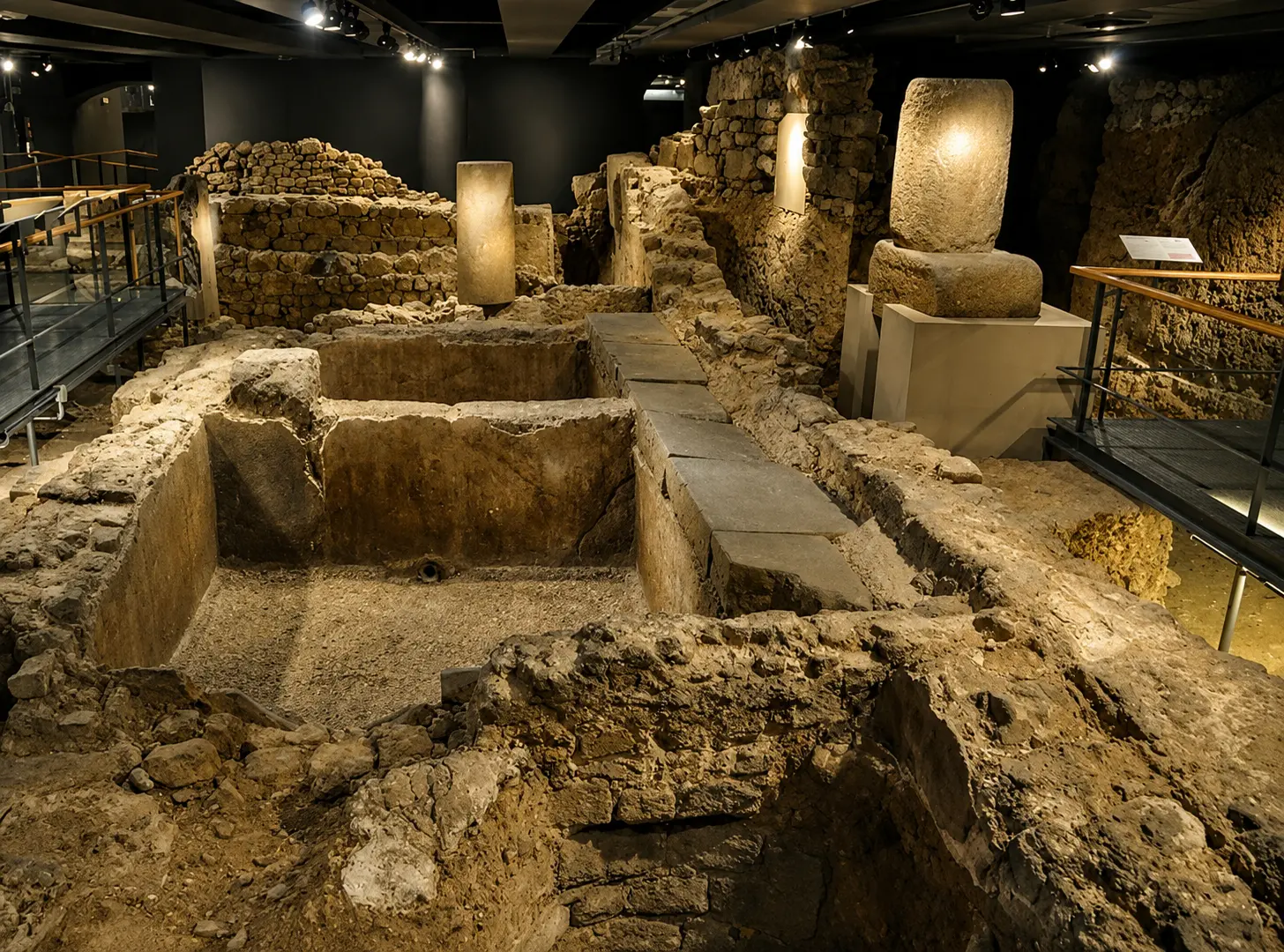
- The MUHBA (Plaça del Rei): the best place to literally go underground and walk the streets of original Roman Barcino.
Roman Barcino, the hidden layer beneath your feet
What makes the Gothic Quarter truly special is that most of its Roman history isn't visible at first glance: you need to know where to look. The original walls can be traced in specific stretches (Plaça Nova, Carrer de la Tapineria, Plaça Ramon Berenguer), and the forum, the baths and the urban fabric of Barcino lie hidden beneath the current streets.
That's why many people who visit the neighbourhood on their own end up seeing "old stones" without understanding their context. A specialist guide makes the difference between walking through the Gothic Quarter and truly understanding it: where the forum was, why the walls were extended in the 3rd century, or how a simple marble column survived two millennia in the middle of a private building.
If you'd like to go deeper, our Barcino: The Roman City free tour covers exactly this itinerary (the towers of Plaça Nova, the Temple of Augustus, the forum and the MUHBA remains), led by a historian guide, pay-what-you-want.
How much time you need to visit the Gothic Quarter
It depends on the level of detail you're after:
- Quick visit (1.5-2 hours): Cathedral, Plaça Nova, Plaça del Rei, Plaça Sant Jaume and El Call, walking without stopping too much.
- Full visit (half a day): add the MUHBA, the Temple of Augustus at a relaxed pace, Santa Maria del Pi and a coffee at Plaça Reial.
- Guided visit (about 2 hours): the option that makes the best use of your time, since a guide takes you straight to the key points and explains their context, so you don't miss anything important along the way.
Whichever option you choose, we recommend not cramming in too many other neighbourhoods the same day: the Gothic Quarter is best walked without rushing, getting a little lost in its alleys between stops.
How to get there and the best time to go
The Gothic Quarter is 100% central and easily reached on foot from anywhere in Ciutat Vella. By public transport, the nearest metro stops are Jaume I (L4) and Liceu (L3). You don't need a car, and we wouldn't recommend bringing one: the streets are mostly pedestrian.
As for timing, weekday mornings (before 11am) and afternoons from 6pm onward see the least crowding. In summer, avoid the middle of the day: the narrow streets offer shade, but the Cathedral and the main squares can fill up with tour groups between 11am and 2pm.
Frequently asked questions about the Gothic Quarter
How many days do I need to visit the Gothic Quarter?
A single morning is enough to see the main highlights. If you're especially interested in Roman and medieval history, and want to take your time at the MUHBA and the Temple of Augustus, it's worth setting aside a full day, combined with a lunch break in one of its corners.
Is the Gothic Quarter safe at night?
Generally yes, it's one of the busiest and most watched neighbourhoods in the city. As in any heavily visited tourist area, we recommend the usual common sense: keep an eye on your belongings, especially in narrow, poorly lit streets away from the main routes.
Can you visit the Gothic Quarter for free?
Yes. Walking its streets, seeing the Roman towers at Plaça Nova, the Temple of Augustus from the outside, or the exterior of the Cathedral costs nothing. You'll only need to pay if you want to access specific spaces, such as the inside of the MUHBA or certain areas of the Cathedral. Our free tours are also pay-what-you-want.
What's the best time of year to visit?
Spring (April-June) and autumn (September-October) offer pleasant temperatures and less crowding than summer. If you go in summer, the narrow streets of the Gothic Quarter provide shade, but the main squares can get quite full between 11am and 2pm.
Do I need to book to join the Gothic Quarter free tour?
Yes, we recommend booking your spot in advance through our contact form, especially in summer or on weekends, since groups are kept small to guarantee a good experience with the guide.
Visit the Gothic Quarter with a local guide
Reading about the Gothic Quarter is a good start, but the best way to understand it is to walk it with someone who knows every corner. Our Roman Barcelona free tour is pay-what-you-want (there's nothing to pay to book a spot, and at the end you leave whatever tip you consider fair) and is always led by historians, not seasonal students.
If you'd rather do the route on your own, at your own pace, we also have a self-guided audio tour version, with the same content explained step by step. Whichever option you choose, you'll leave the Gothic Quarter looking at its streets in a different way.