
Between the 11th and 15th centuries, Barcelona became the centre of one of the most powerful maritime empires in the Mediterranean. An exceptional Gothic heritage survives from that period, packed into a relatively small area of the city centre. If medieval Barcelona interests you, this guide explains what to visit, in what order, and why it's worth understanding the context before taking the photos.
Barcelona, capital of a Mediterranean empire
Medieval Barcelona didn't grow by chance. In the 13th and 14th centuries, the Crown of Aragon controlled trade routes from Sardinia to Greece, and Barcelona was the main port of that network. Merchants enriched by maritime trade financed some of the most important Gothic buildings in Europe: cathedrals, exchanges, hospitals and palaces that still define the city's historic centre today.
This Catalan Gothic style has its own character: more horizontal and solid than French Gothic, with less ornamentation and more structural strength. It's especially noticeable in civil buildings, like the Llotja de Mar or the Saló del Tinell.
Guilds and everyday life in medieval Barcelona
Beyond the great buildings, medieval Barcelona was organised around craft guilds: weavers, silversmiths, coppersmiths, carpenters... each with its own street or square, many of which still bear the name of the trade that once dominated it: Carrer Boters, Carrer Argenteria and Carrer Corders are good examples.
These guilds weren't just professional associations: they regulated prices, quality and working conditions, and held significant political weight in the city, with representation on the Consell de Cent, the medieval municipal governing body. Walking through the trade-named streets between the Born and the Gothic Quarter is a simple way to get a sense of how that urban society was organised, long before modern trade unions existed.
What to visit in medieval Barcelona: recommended itinerary
- Cathedral of the Holy Cross and Saint Eulalia: built between the 13th and 15th centuries over an earlier Romanesque basilica. A natural starting point for any medieval route.
- Plaça del Rei and the Saló del Tinell: the royal complex of the count-kings, with one of the most impressive civil Gothic spaces in the city.
- El Call, the old Jewish quarter: narrow, winding streets that preserve the original layout of the medieval Jewish community, active until the pogrom of 1391.
- Carrer Montcada: the avenue of the great medieval merchants, today lined with Gothic palaces, some turned into museums.
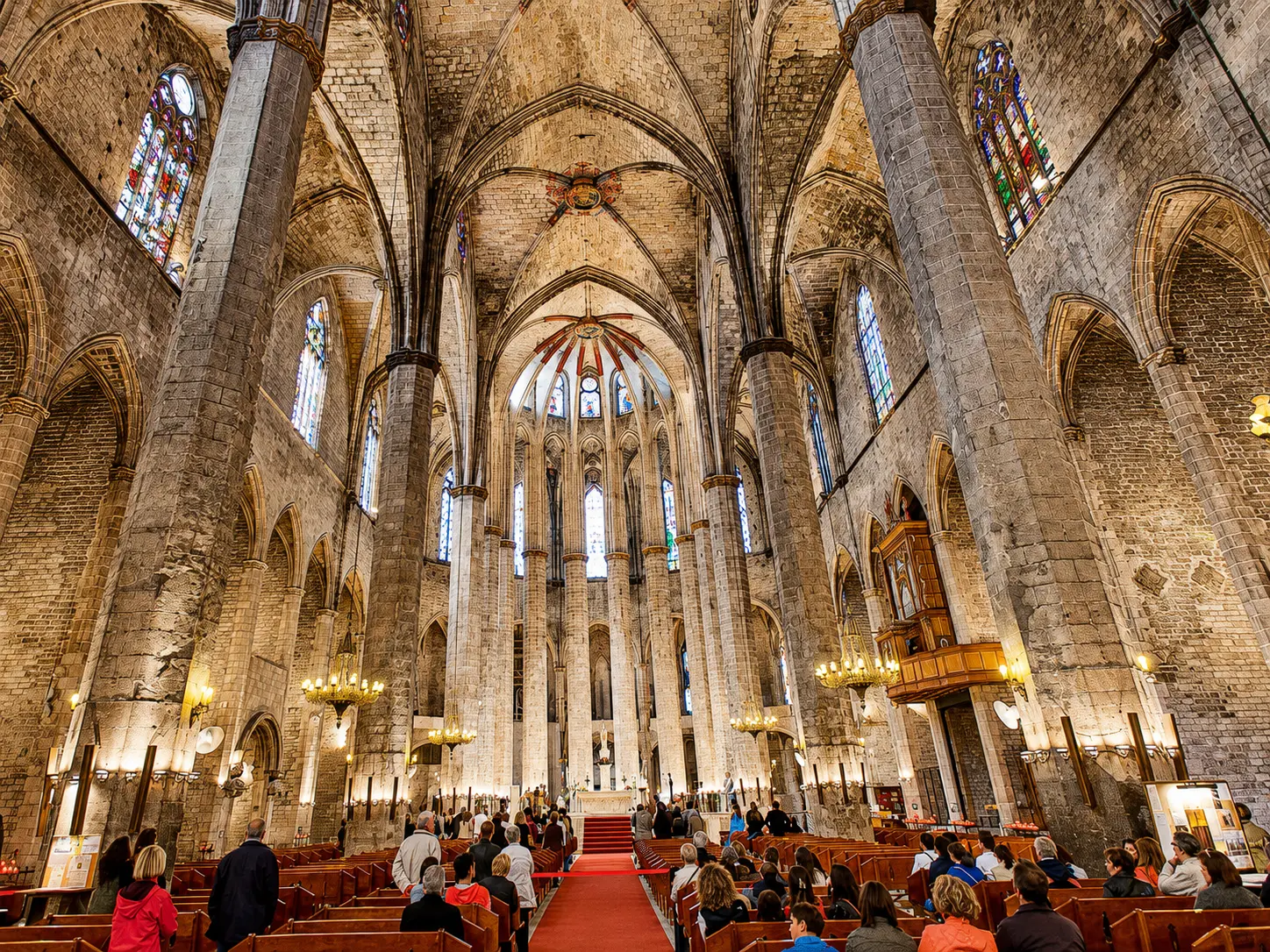
- Santa Maria del Mar: the Gothic basilica built by the people of the Ribera (dockworkers and sailors) in just 54 years, a record for its time.
- El Born and the Mercat del Born: beneath the market lie archaeological remains of the neighbourhood destroyed in 1714.
- La Llotja de Mar: the seat of medieval maritime trade, one of the finest examples of Catalan civil Gothic preserved in Europe.
El Call: the Jewish Barcelona that almost disappeared
Within the medieval route, El Call deserves a mention of its own. Between the 12th and 14th centuries it was one of the most important intellectual centres in the Crown of Aragon: physicians who treated kings, philosophers, cartographers and merchants with connections across the Mediterranean made it a hub of learning. On 5 August 1391 a mob stormed Barcelona's Call: hundreds of people died, many more were forced to convert, and the neighbourhood was left virtually erased. Today the original layout can be traced along Carrer del Call, Sant Domènec del Call and Marlet, and the MUHBA maintains a section dedicated to its memory there. For more, see our full guide to what to visit in Barcelona's Jewish Quarter.
Santa Maria del Mar: the cathedral built by the people
If you had to pick a single building to understand the spirit of medieval Barcelona, make it Santa Maria del Mar. Unlike most European cathedrals, financed by the monarchy or the Church, this basilica was built by the residents of the Ribera neighbourhood (especially the bastaixos, the port's dockworkers) who carried the stones on their backs from the Montjuïc quarry.
The result is a unique structural purity: slender columns, light pouring in through the great windows, and a sense of harmony that the Gothic architects themselves rarely achieved again. Construction was completed in just 54 years (1329-1383), a record compared to the centuries other cathedrals of the time took to build.
How much time you need and how to plan the visit
To do the medieval route justice, allow 2 to 3 hours of unhurried walking, not counting waiting time to enter fee-charging buildings. A good order is: Cathedral → Plaça del Rei → El Call → Plaça Sant Jaume → Carrer Montcada → Santa Maria del Mar → El Born.
The best times to avoid crowds are early morning (before 10am) or mid-afternoon (from 5pm onward). On Sundays, many churches (including Santa Maria del Mar) have mass schedules that can limit tourist visits during certain time slots.
Frequently asked questions about medieval Barcelona
What are the most important medieval buildings in Barcelona?
The Cathedral, the Palau Reial Major (Plaça del Rei), Santa Maria del Mar, the Llotja de Mar and the Gothic palaces on Carrer Montcada are the most notable surviving examples of Catalan Gothic in the city. Together they form one of the most complete urban Gothic ensembles in Europe.
Can you enter Santa Maria del Mar for free?
Access for worship, during mass times, is usually free. Outside those hours, the tourist visit to the interior and, especially, access to the terraces, carry an entrance fee you can check on the basilica's official website.
How much does it cost to visit Carrer Montcada and its palaces?
Walking along Carrer Montcada costs nothing: it's a public street. Some of the palaces along it have become museums (such as the Museu Picasso) and do require paid admission to visit their interiors.
What's the difference between Catalan Gothic and French Gothic?
Catalan Gothic (visible at Santa Maria del Mar or the Llotja de Mar) tends to be more horizontal, solid and austere than French Gothic, with less ornamentation and more emphasis on the width of interior spaces. It's considered one of the most distinctive regional variants of European Gothic architecture.
Can you visit medieval Barcelona with kids?
Yes, it's one of the most rewarding routes for families: the narrow streets, squares full of history, and legends like that of Sant Jordi keep young ones easily engaged, especially if the explanation comes with anecdotes rather than just dates.
How much does it cost to enter Barcelona Cathedral?
General access for worship is free at certain times. The full tourist visit, with access to the choir, the terraces or the chapter museum, carries an entrance fee you can check on the Cathedral's official website before going, as it can vary by season.
Do the route with a historian guide
Our Medieval Barcelona free tour covers exactly this itinerary (Cathedral, Plaça del Rei, El Call, Carrer Montcada and Santa Maria del Mar), led by a historian, pay-what-you-want. It's the most efficient way to understand in two hours what would otherwise take days of reading, and to not miss any of the details that go unnoticed at first glance.
You can also do the same route on your own with our self-guided audio tour, available 24 hours a day with no need to book a time slot.