
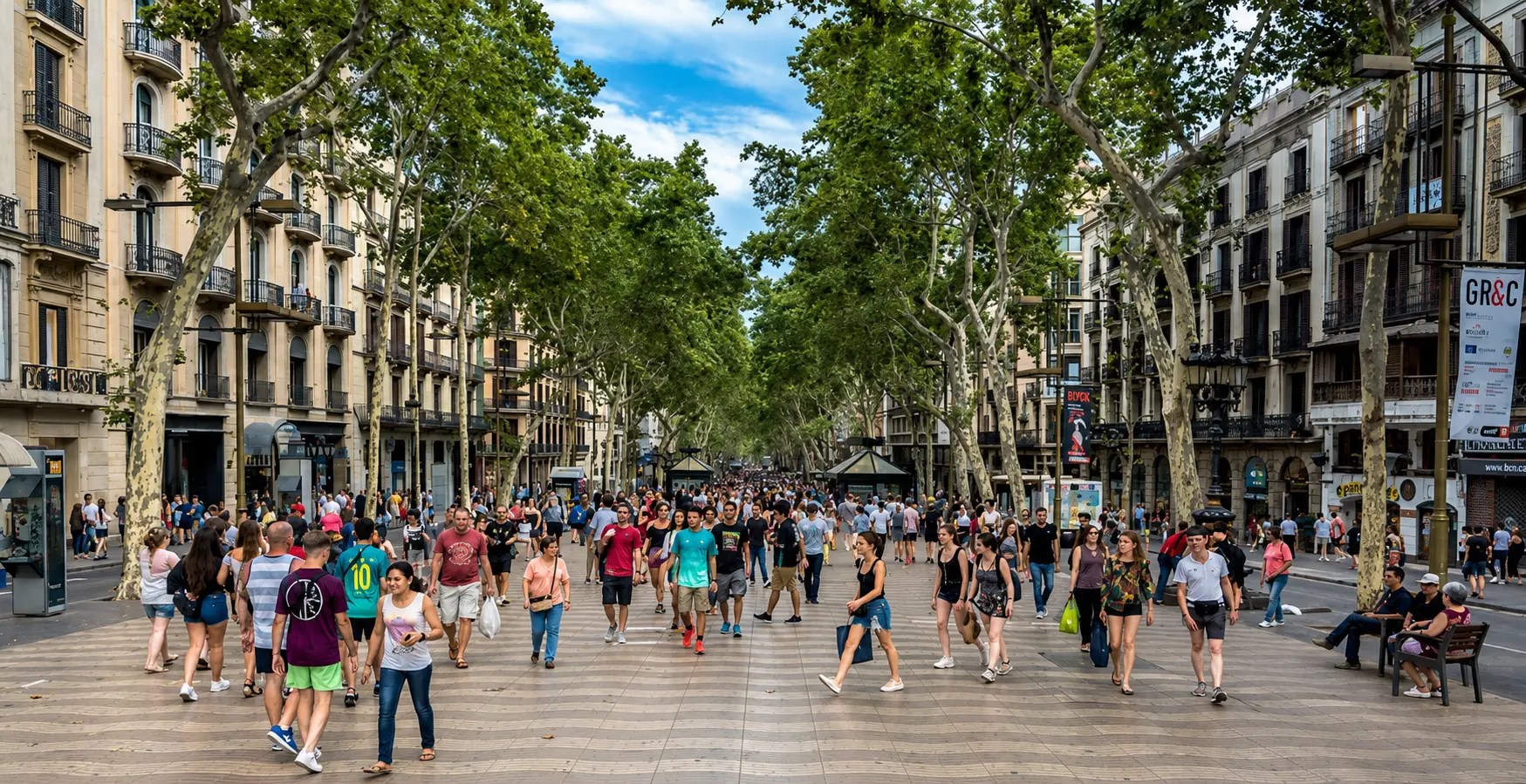
Las Ramblas is, probably, the best-known street in Spain and one of the most photographed in Europe. It's also one of the most misunderstood places by those who visit it: most tourists walk through quickly, unaware they're treading the former bed of a medieval stream, or that right there, in the summer of 1936, barricades once went up.
This guide explains what to visit on Las Ramblas, how it's structured, what history it hides, and how to make the most of it without falling purely into mass tourism.
A stream that became the city's most famous street
The word "rambla" comes from the Arabic raml (sand) and refers to the dry bed of a stream that, until the 14th century, ran outside Barcelona's medieval walls. When the city expanded and built a new wall, the stream ended up inside the urban perimeter and gradually became a public space: first a dirt path between convents, then a tree-lined promenade, and finally the central artery of modern Barcelona.
That's why Las Ramblas is not, technically, a single street: it's five consecutive sections, each with its own name and character.
The five sections of Las Ramblas
- Rambla de Canaletes: the section closest to Plaça Catalunya, known for the Font de Canaletes fountain: legend says whoever drinks from it will return to Barcelona.
- Rambla dels Estudis: named after the old university that once stood on this stretch.
- Rambla de Sant Josep (of the Flowers): traditionally lined with flower stalls, and home to the entrance to the Mercat de la Boqueria.
- Rambla dels Caputxins: the widest section, with the Gran Teatre del Liceu and the famous Joan Miró mosaic on the pavement.
- Rambla de Santa Mònica: the final stretch before reaching the Columbus Monument and the sea.
What to visit on Las Ramblas and nearby
- Mercat de la Boqueria: one of the oldest and liveliest municipal markets in Europe, right off the Rambla.
- Gran Teatre del Liceu: one of the most important opera houses in the world, rebuilt twice after separate fires.
- Joan Miró mosaic: set into the pavement in front of the Liceu, often walked over without anyone noticing.
- Palau Güell: an early work by Antoni Gaudí, a few metres from the Rambla, on Carrer Nou de la Rambla.
- Columbus Monument: at the end of the promenade, facing the sea, erected for the 1888 Universal Exposition.
- Plaça Reial: right next door, a 19th-century arcaded square, ideal for a break away from the crowds.
From stream to boulevard: how Las Ramblas changed in the 19th century
The definitive transformation of Las Ramblas into the monumental promenade we know today came in the 19th century, when Barcelona tore down its medieval walls and underwent rapid urban growth. The convents that originally lined the promenade were gradually secularised and replaced with bourgeois buildings, theatres and cafés, while the dirt pavement became the tree-lined boulevard we know.
It was also the era when Las Ramblas filled with newspaper kiosks, flower stalls and caged birds, the latter a tradition that has faded in recent decades amid criticism over animal welfare. That 19th-century boulevard, designed for the bourgeoisie's Sunday strolls, is the direct origin of the crowded, tourist-filled Las Ramblas we experience today.
1936: when Las Ramblas were the epicentre of a revolution
Few visitors know that Las Ramblas were, during the summer of 1936, the stage for one of the most radical social revolutions in European history. With the outbreak of the Civil War, armed militia members, women in blue overalls, and trucks full of anarchist union members filled the same promenade tourists now stroll along with their suitcases.
The writer George Orwell, who fought in Barcelona during those months, described Las Ramblas as "the most beautiful place in the world" during those revolutionary days, when it seemed to him that the working class had seized power for the first time. This layer of historical memory (as present as it is forgotten) is precisely the thread running through our Memory of '36 free tour, which dedicates a special stop to Las Ramblas of that era.
Practical tips: when to visit and how to avoid tourist traps
Las Ramblas receives over 50,000 people a day, which drives up prices at many of the bars and restaurants right on the promenade. Practical recommendations:
- Avoid eating or drinking directly on the Rambla: the side streets (Gothic Quarter or Raval) offer much better value for money.
- Watch your belongings: it's an area with a regular pickpocket presence, as in any major tourist artery in Europe.
- Visit the Mercat de la Boqueria early in the morning, when it still functions as a neighbourhood market rather than purely a tourist attraction.
- Walk all the way to the end, to the Columbus Monument: most tourists stop halfway and miss the view of the port.
Frequently asked questions about Las Ramblas
How long does it take to walk the whole of Las Ramblas?
Walking the roughly 1.2 km of Las Ramblas, end to end without stopping, takes about 20-25 minutes. With stops at the points of interest (the Boqueria, the Liceu, the Miró mosaic), allow 1 to 1.5 hours.
Is Las Ramblas safe to walk?
Yes, it's one of the areas with the strongest police presence in the city. The main risk isn't physical safety but pickpockets, common on any major tourist artery with such heavy footfall. We recommend keeping belongings in sight and avoiding taking out your phone or wallet unnecessarily in the crowd.
Why is Las Ramblas plural in name?
Because, technically, it isn't a single street but a sequence of five different sections: Canaletes, Estudis, Sant Josep, Caputxins and Santa Mònica, each with its own name and character, even though today they're perceived as one continuous promenade.
Is it worth eating on Las Ramblas?
Generally not the best option: establishments right on the promenade tend to have higher prices and more inconsistent quality than those on the side streets of the Gothic Quarter or Raval, just a few metres away.
What's the best spot for photos on Las Ramblas?
The Miró mosaic, in front of the Liceu, and the view from the Font de Canaletes looking down the promenade, are two of the most photographed spots. For a shot with fewer people, try early morning, before the tour groups arrive.
Can you combine a visit to Las Ramblas with nearby neighbourhoods?
Yes, that's one of its great advantages: Las Ramblas connects directly with the Gothic Quarter on one side and the Raval on the other, making it easy to design a continuous walking route through the historic centre without needing transport.
What's the closest metro stop to Las Ramblas?
It depends on the section: Catalunya (L1, L3) for the northern end, Liceu (L3) for the middle section, and Drassanes (L3) for the southern end, near the Columbus Monument.
Experience the real history of Las Ramblas with a guide
Walking Las Ramblas without context means missing half its story. Our Memory of '36 free tour covers this promenade and the Gothic Quarter, explaining the Civil War events that took place there, with a historian guide and pay-what-you-want. You can also do the route as a self-guided audio tour if you'd rather go on your own.