
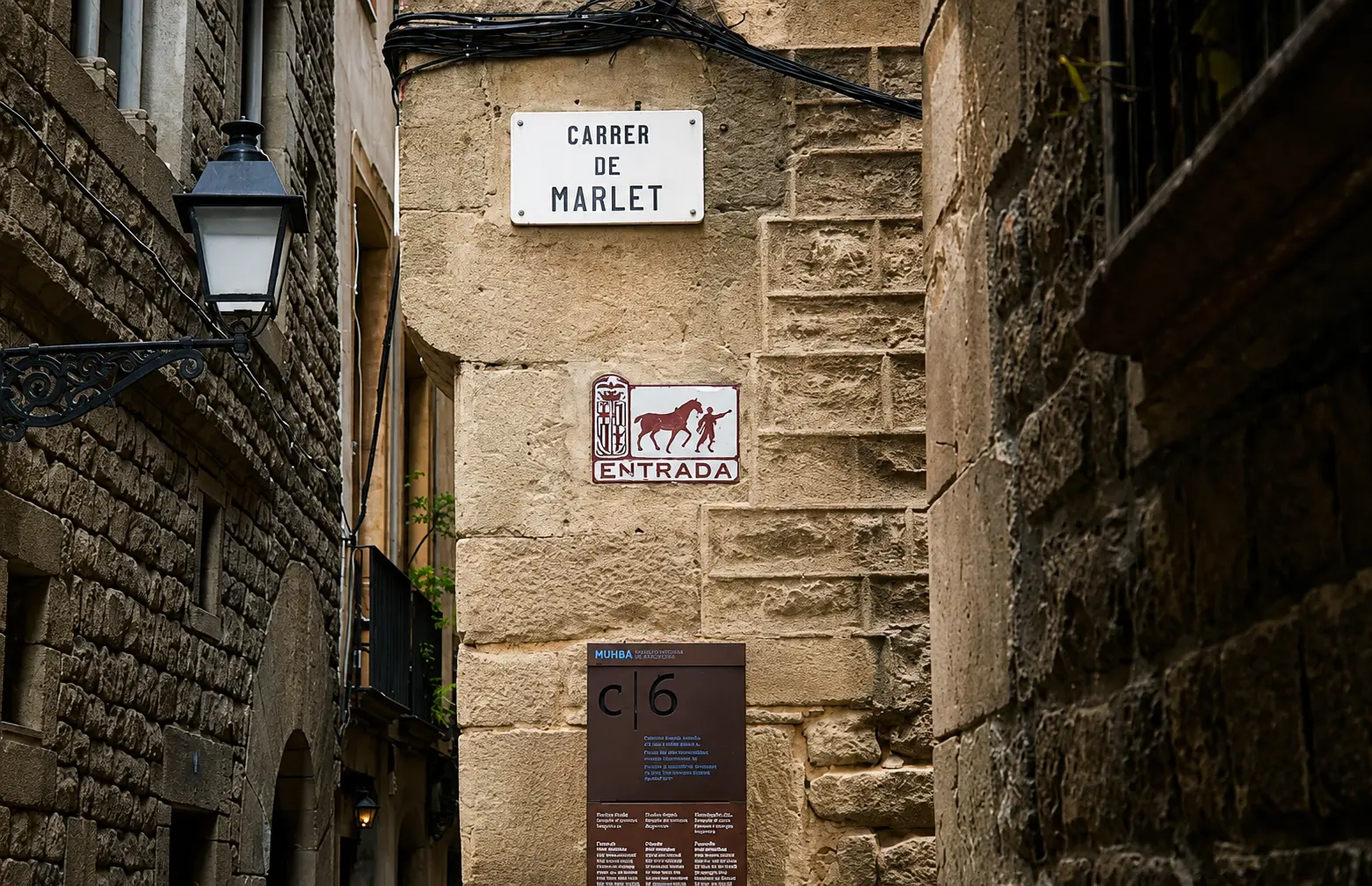
In the middle of the Gothic Quarter, within an area of just a handful of streets, once stood one of the most important Jewish neighbourhoods of the medieval Mediterranean. Today, most visitors walk right past it without knowing: there are no grand monuments or huge signs, just narrow streets with names that still recall that history. This guide explains what to visit in Barcelona's Call and why it's worth seeking out on purpose.
What Barcelona's Call was
El Call (from the Hebrew word qahal, "community") was the neighbourhood where Barcelona's Jewish community lived from at least the 9th century onward. Between the 12th and 14th centuries it experienced its golden age: physicians who treated kings, philosophers, cartographers and merchants with connections across the Mediterranean made it one of the most important intellectual centres in the Crown of Aragon.
Barcelona's rabbinical school was one of the most prestigious in Europe, and figures such as Nahmanides (one of the great medieval Jewish thinkers) were born and studied there. None of this is obvious today at first glance, which is why most visitors walk through El Call without realising it.
What to visit in El Call: streets and points of interest
- Carrer del Call: the neighbourhood's main axis, which still preserves its original medieval layout.
- Carrer de Marlet: home to a 14th-century Hebrew inscription, considered the oldest preserved in Catalonia.
- Great Synagogue (Call Interpretation Centre): believed to occupy the site of one of the city's medieval synagogues, today it's a small museum open to the public.
- Carrer de Sant Domènec del Call: another of the narrow streets that once marked the neighbourhood's perimeter.
- Arc de Sant Ramon del Call: a covered passage connecting two streets, typical of the medieval Jewish urban layout.
- MUHBA – Call section: the Museum of the History of Barcelona maintains a small permanent exhibition here dedicated to the memory of the Jewish community.
The 1391 pogrom: the violent end of a community
On 5 August 1391, a mob stormed Barcelona's Call in one of the most violent pogroms in medieval Spanish history. Within hours hundreds of people were killed; many more were forced to convert to Christianity under threat, and the neighbourhood was looted and virtually razed.
"The causes were manifold: economic crisis, antisemitic preaching and the social tensions of the moment. But the result was the destruction of one of the most brilliant intellectual communities of medieval Barcelona."
This isn't just a distant historical fact: it's one of the keys to understanding how Barcelona lost part of its medieval cultural diversity, and why so many streets in El Call went, for centuries, without any visible reference to the neighbourhood's Jewish origin.
What everyday life was like in the medieval Call
El Call wasn't just a place of residence: it was a self-contained microcosm, locked every night behind guarded gates, with its own butchers, bakers and notaries, since Jewish law regulated aspects of daily life (such as diet) that didn't always match the Christian customs of the rest of the city.
Barcelona's Jews were formally under the king's direct protection, which gave them a degree of legal stability in exchange for fairly high specific taxes. This direct dependence on the Crown partly explains why El Call was able to thrive intellectually and economically for centuries, but also why it became so exposed once that royal protection weakened toward the end of the 14th century.
The most common occupations within the community were medicine, moneylending, goldsmithing and long-distance trade: activities that required a high level of literacy and international networks, uncommon at the time outside this community.
How to find El Call today: practical tips
El Call has no single entrance or large signs marking its boundaries, so it's easy to walk right past it without noticing. The clearest landmarks to orient yourself are Carrer del Call itself (which starts near Plaça Sant Jaume) and Carrer de Marlet, home to the Hebrew inscription.
We recommend visiting early in the morning, when the narrow streets are still quiet; by mid-morning and in the afternoon they become a thoroughfare for tour groups heading to the Cathedral. The Call Interpretation Centre has reduced opening hours, so if you want to go in, it's worth checking the current schedule before you go.
Frequently asked questions about Barcelona's Call
Is there an original synagogue still standing in El Call?
Not with absolute certainty. The building known today as the Great Synagogue, open as an interpretation centre, is believed to occupy the site of one of the medieval synagogues, but the current building has undergone multiple transformations over the centuries.
Is it free to visit El Call?
Walking its streets is completely free, since it's public space. Only entry to the Call Interpretation Centre (the former Great Synagogue) carries a symbolic admission fee.
How much time do you need to visit El Call?
Between 30 and 45 minutes is enough to walk the main streets at a relaxed pace. If you want to go into the interpretation centre and read the information panels in detail, allow an hour.
Why is El Call so hard to find?
Because, unlike other historic Jewish quarters in Europe, Barcelona's Call has no visible walls or gates marking it out: after the 1391 pogrom the neighbourhood was gradually absorbed into the urban fabric of the Gothic Quarter, and only street names and a few isolated remains recall its existence.
Are there other Jewish quarters in Catalonia you can visit?
Yes, Girona preserves one of the best-preserved Jewish quarters in Europe, with a museum dedicated in depth to its history. Comparing it with Barcelona's helps you better understand how these communities lived in medieval Catalonia, though each city has its own particularities.
Can you visit El Call with a wheelchair or a stroller?
The pavement on its streets is uneven, typical of a medieval layout, which can make access with a wheelchair or stroller difficult. It's passable with care, but worth factoring into your route planning.
What's the best time of day to visit El Call?
Morning, between 9am and 11am, offers the best combination of light and quiet, before the streets fill with visitor groups heading toward the Cathedral.
Is it worth visiting El Call if I've already seen the Gothic Quarter?
Yes, without a doubt: many visitors walk through El Call without even noticing, because there are no grand monuments to mark it. Knowing where to look completely transforms your perception of those same streets.
El Call within the medieval Barcelona route
El Call isn't fully understood as an isolated visit: it's part of a broader itinerary through medieval Barcelona, alongside the Cathedral, Plaça del Rei and Santa Maria del Mar. For the full picture, we recommend our guide on what to visit in medieval Barcelona.
Our Medieval Barcelona free tour includes a stop in El Call with the full story, led by a historian guide, pay-what-you-want. You can also do the route on your own with our self-guided audio tour.